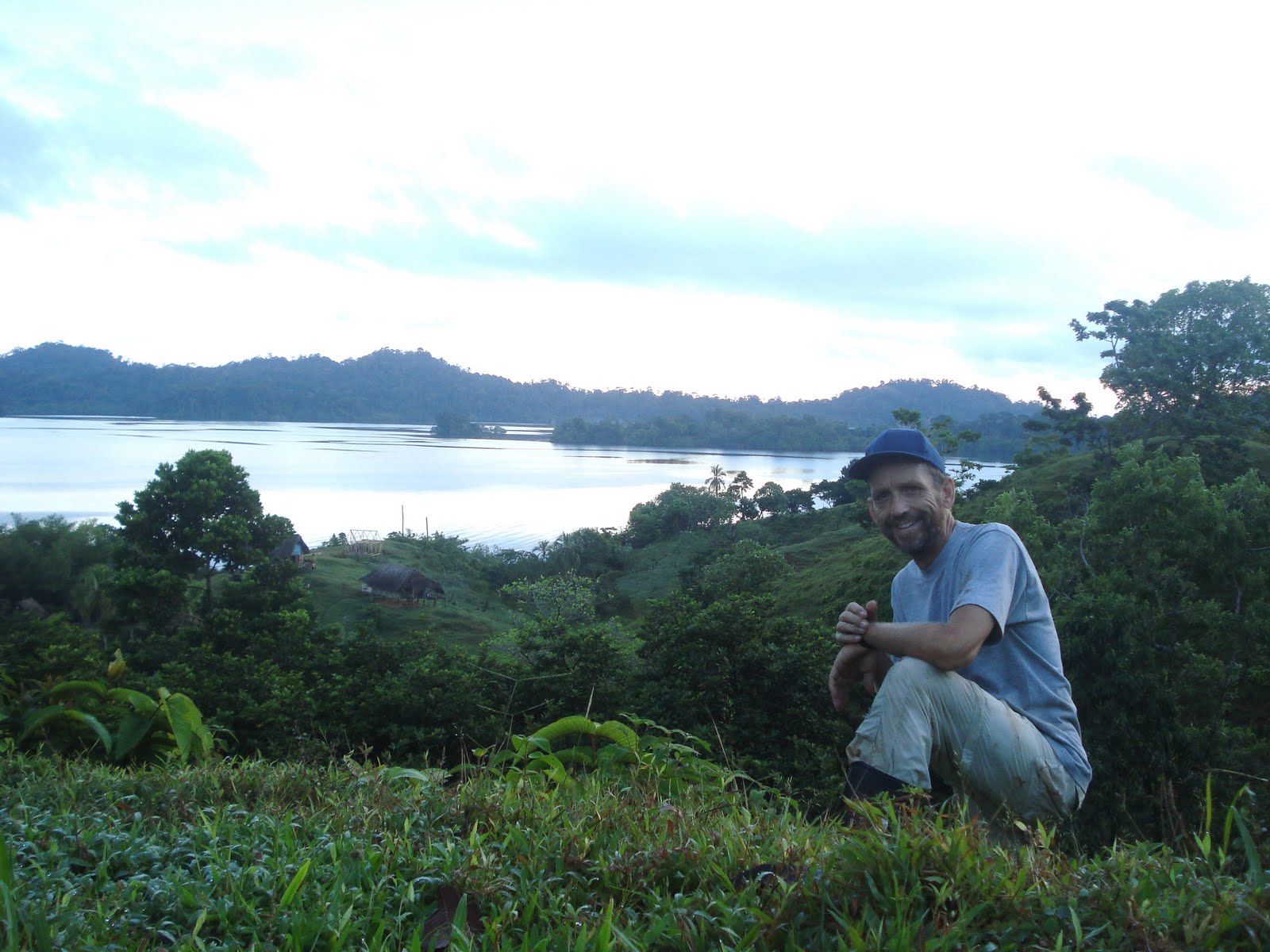
What we have in lieu of latrines or toilets are the local quebradas, the little creeks that flow down from the hills and empty into the bay. And we have the bay itself.
 Sometimes there is a little ramshackle privy set up over the water with a servicio that just amounts to a couple of boards strategically spaced above the water to allow for comfortable squatting. Or when people have their house built out over the water along the bay they may have a hole in the floor of a back room.
  and do their business directly.
That's the grim and grotty reality of sanitation in most of the indigenous Ngäbe communities in Panama, and improving that situation is a primary goal of Peace Corps' Environmental Health project. And that means latrines. It all seemed pretty straightforward when I received my invitation to serve, and I thought it sounded great to come down here and help these people out by building latrines. Of course, it turns out to be more complicated than that on many levels. For one thing, the old Scout camp style pit latrine we're all familiar with is a no-go in this corner of the tropics. The the water table is so high that if you try to dig a pit you'll hit ground water within a few feet. The solution Peace Corps has been promoting is the "double-vault" composting latrine. It's an above ground, cement block structure that stores all the poo in two "vaults" below the floor. You mix in some organic material like dry grass and sawdust and given enough time it will all turn to compost.
 There are two seats, one above each tank, but the idea is to seal one off and use just one vault for the first year, then leave it alone to continue composting for the second year while you switch over to the other seat and fill the second vault. After that second year you should be able to remove finished compost from the first vault, spread it around your farm, and start the cycle over.
  Sounds easy enough. And the Ngäbe fellow on the poster seems to be happy with it. So why were none of the eight families in Bahia Azul who were part of the the 2005 latrine project using their latrines when I got there in October of 2009 ? That's a really good question, and one I felt like I needed to find some good answers to before sinking a lot of resources into building more composting latrines. My community isn't unique in this respect. A follow-up study a couple of years ago found that a very low percentage of the latrines we had built in Ngäbe communities out in this region were actually being used once the volunteers left. Meanwhile, the tell-tale swollen bellies of the children suggest the density of the parasite population inside, and the Ngäbe people continue to register the highest mortality rate attributed to diarrhea in children under five in Panama.
  I'm still struggling to figure it out, but one element of the problem has to do with a basic culture clash : Wipers versus Washers. While we learn from our potty training days to use toilet paper to clean up after pooping, Ngäbes have always used water. If they're squatting in the creek, it's an easy thing to take a step or two up stream, squat back down and get nice and clean. Or if they're going to a privy, they'll carry a little jug of water along for their ablutions. To them, wiping with paper is cochino or filthy. Okay, to each his own. But here's the rub: the composting latrine is a dry latrine. The vault can't be all soggy or it will be a smelly, bug infested mess. You can't urinate down into it, let alone dump a lot of wash water in there. The seats of the latrine are specially designed with a urinal section in the front that allows the urine to drain off through a pipe into a soak trench in the ground outside.
  The challenge has been to come up with a way to accomodate the cultural difference. If these folks lived in Panama City, and if they had the money, they could go to the home center and find something like this...
  After a lot of head scratching, I came up with a campo version that I´ve been calling the Ngäbe Bidet, or in Spanish, El Lavanalgas. It's a little ferrocement basin that fits onto the latrine seat over on the seat that's not in use. The basin covers up the opening to the tank below and water flows down into the urinal and drains into the soak trench outside.
 So after a sit-down on the active side seat, one can step over to the other seat and take care of one's washing. The icing on the cake is the little garden hose sprayer we hooked up to a a tank of rainwater collected off of the roof.
 The early reaction has been really positive, so we´ll be retrofitting a few more of the old latrines that we're trying to get into full service, including one that will be a model latrine for people to come and try out if they want to be involved in another round of latrine building in the community. Thanks to Danny Hurtado, a former volunteer and Michigan Tech student who did his masters thesis on the sanitation situation in this region. I snagged a couple of photos from his paper.


 Until I get the chance to do it, I don't realize how much I miss having a conversation in English, and especially with someone who is sharing this same special and somewhat crazy experience as me.


 We'd gotten about as far upstream as you can go without getting out and dragging your canoe, when the calm was broken by a raucous clamoring in the distance that Kelly guessed was a pack of wild dogs, but that I recognized immediately as something much more animated than that: a junta of Ngabes hauling a dugout boat up out of the woods and down to the river. We parked our canoe and hiked in a ways to see the men struggling through the mud to drag the massive boat out.