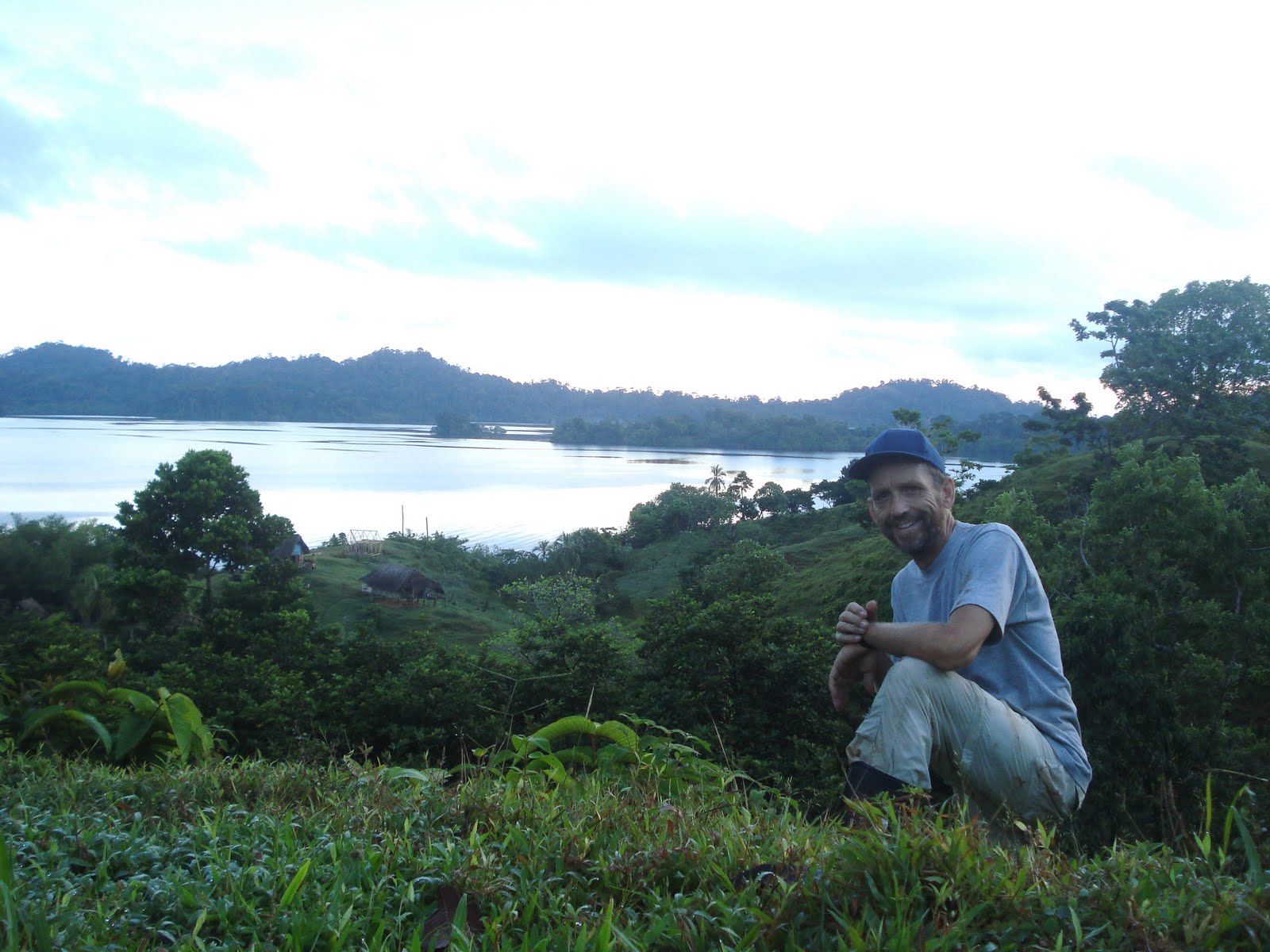
After such a long hiatus from posting to this blog I've been feeling a little writer's block. So instead of trying to talk about all the things I've been up to I'm just going to break the ice again with a little snapshot of my life in Peace Corps Panama ,
I took a few days away from my home in Bahía Azul and paddled across the bay where a trail leads over to a community called Playa Balsa, where my fellow volunteer and very good friend Charles lives. It's also one of the most stunningly beautiful places you could ever hope to visit, let alone live and work.
This wasn't a vacation though. I went to help out with construction of a small water storage tank for an aqueduct the town is building. The local men had already done some of the hardest physical work you can imagine, hauling tons of rock, sand, rebar and cement through treacherously muddy forest trails and up the steep hills|to where the the water tank was to be built. Making this hike empty handed left me winded, so loading a 95 pound bag of cement into a chakara and strapping it to my head like the muchachos were doingnever even entered my mind.
We broke ground and started setting up forms, and some girls carried a bucket of water up from a nearby stream to make chicha to drink.
Each day while we worked with a crew of men on the hilltop, women were preparing lunch down in town.
Boiled green bananas with rice and little sardines might not be considered gourmet cuisine, but it certainly is filling
The work days were long and hard, but the tank construction went great. The rains came and went with fortuitous timing and we got the foundation , floor, and first level of walls all poured as planned.
The day I was heading for home, clouds moved in and I walked the forty five minutes back to the bay in a steady warm rain that was drenching, but at the same time welcome. Another forty minutes of paddling and I was back home, back in my hut, relaxing in my hammmock, weary but satisfied, warmed by a nice glass of rum and the images of loved ones in the glow of the candles, very, very happy to still beafloat here in Panama.
The United Nations estimates that 2.5 billion people worldwide lack access to basic sanitation, and my community of Bahia Azul has around five hundred of them. That includes just about everybody if you include the families that had a latrine built by a previous Peace Corps volunteer, because all of their latrines had fallen in to disuse if they were ever completed and used in the first place.
What we have in lieu of latrines or toilets are the local quebradas, the little creeks that flow down from the hills and empty into the bay. And we have the bay itself.
Sometimes there is a little ramshackle privy set up over the water with a servicio that just amounts to a couple of boards strategically spaced above the water to allow for comfortable squatting. Or when people have their house built out over the water along the bay they may have a hole in the floor of a back room.
Or they just wade into the water... and do their business directly.
That's the grim and grotty reality of sanitation in most of the indigenous Ngäbe communities in Panama, and improving that situation is a primary goal of Peace Corps' Environmental Health project. And that means latrines. It all seemed pretty straightforward when I received my invitation to serve, and I thought it sounded great to come down here and help these people out by building latrines. Of course, it turns out to be more complicated than that on many levels. For one thing, the old Scout camp style pit latrine we're all familiar with is a no-go in this corner of the tropics. The the water table is so high that if you try to dig a pit you'll hit ground water within a few feet. The solution Peace Corps has been promoting is the "double-vault" composting latrine. It's an above ground, cement block structure that stores all the poo in two "vaults" below the floor. You mix in some organic material like dry grass and sawdust and given enough time it will all turn to compost.
There are two seats, one above each tank, but the idea is to seal one off and use just one vault for the first year, then leave it alone to continue composting for the second year while you switch over to the other seat and fill the second vault. After that second year you should be able to remove finished compost from the first vault, spread it around your farm, and start the cycle over. Sounds easy enough. And the Ngäbe fellow on the poster seems to be happy with it. So why were none of the eight families in Bahia Azul who were part of the the 2005 latrine project using their latrines when I got there in October of 2009 ? That's a really good question, and one I felt like I needed to find some good answers to before sinking a lot of resources into building more composting latrines. My community isn't unique in this respect. A follow-up study a couple of years ago found that a very low percentage of the latrines we had built in Ngäbe communities out in this region were actually being used once the volunteers left. Meanwhile, the tell-tale swollen bellies of the children suggest the density of the parasite population inside, and the Ngäbe people continue to register the highest mortality rate attributed to diarrhea in children under five in Panama. I'm still struggling to figure it out, but one element of the problem has to do with a basic culture clash : Wipers versus Washers. While we learn from our potty training days to use toilet paper to clean up after pooping, Ngäbes have always used water. If they're squatting in the creek, it's an easy thing to take a step or two up stream, squat back down and get nice and clean. Or if they're going to a privy, they'll carry a little jug of water along for their ablutions. To them, wiping with paper is cochino or filthy. Okay, to each his own. But here's the rub: the composting latrine is a dry latrine. The vault can't be all soggy or it will be a smelly, bug infested mess. You can't urinate down into it, let alone dump a lot of wash water in there. The seats of the latrine are specially designed with a urinal section in the front that allows the urine to drain off through a pipe into a soak trench in the ground outside. The challenge has been to come up with a way to accomodate the cultural difference. If these folks lived in Panama City, and if they had the money, they could go to the home center and find something like this... After a lot of head scratching, I came up with a campo version that I´ve been calling the Ngäbe Bidet, or in Spanish, El Lavanalgas. It's a little ferrocement basin that fits onto the latrine seat over on the seat that's not in use. The basin covers up the opening to the tank below and water flows down into the urinal and drains into the soak trench outside. So after a sit-down on the active side seat, one can step over to the other seat and take care of one's washing. The icing on the cake is the little garden hose sprayer we hooked up to a a tank of rainwater collected off of the roof. The early reaction has been really positive, so we´ll be retrofitting a few more of the old latrines that we're trying to get into full service, including one that will be a model latrine for people to come and try out if they want to be involved in another round of latrine building in the community. Thanks to Danny Hurtado, a former volunteer and Michigan Tech student who did his masters thesis on the sanitation situation in this region. I snagged a couple of photos from his paper.
In the year and a half that I've been living out on Peninsula Valiente I don't think I've ever really felt lonely. I mean, I'm pretty much surrounded by people all the time. I often find myself gettting up at five in the morning just so I can savor my morning coffee in the hammock and enjoy a couple of hours of "me" time before things really spring to life and people start dropping by.
Like this crew of kids and their moms who hike the muddy finca trails through the woods to come to school. They know they're welcome, so they come up on the porch to put on their shoes and socks, and starched white uniforms before heading on to class. This was the first day of school and the moms were spritzing all the kids with cologne before sending them on. Pretty darned cute. And of course, being a cut-up, I got in line for my spritz. They love that stuff.
And after school kids are always coming by to hang out a while, usually asking me to let them read one of my books--old newspapers serve the purpose--and maybe catch me in a generous mood when I might give everyone a soda cracker.
And of course I have a lot of adult visitors to, like these guys who came over for our water committee meeting.
So, given that I have so much company, it always surprises me a little how much I relish visits with, as the Ngabes like to say, mi gente -- my people. That's usually a neighboring Peace Corps volunteer, like my friend Charles, who lives out on the other side of the peninsula. I went over a few weeks ago to visit him and help him build a rainwater tank.Until I get the chance to do it, I don't realize how much I miss having a conversation in English, and especially with someone who is sharing this same special and somewhat crazy experience as me.
So it was even more of a thrill when I walked up to my porch one day in February to find that my son Kelly had finally arrived, having made his way down on the bus from a visit back to the site of his Peace Corps service in El Salvador. It was great having him here. To those of you who know Kelly, it will be no surprise to hear that my community loved him. He fell right in, making friends, learning phrases in Ngabere, tickling little kids, and conducting office hours on the front porch.
Despite the fact that it rained almost constantly, we had no problem staying busy for the week or so he was in town. In addition to coming along and helping with aqueduct repairs we worked together to build a sixty-five gallon ferrocement rainwater storage tank. When it was time to precast the base, it was Kelly's inspiration to bring the mud up onto the porch to make the form for the dome shaped bottom plate.
The mud worked perfectly as a form, as did the rest of the project, and the finished tank is full and supplying the water for the washbasin in the latrine I wrote about in the previous blog. Everyone here loves the tanks and a lot of people want me to help them build one of their own. (more to come on this project in another blog post)
We visited just about everyone in the community at one point or other, and paddled over across the bay and up the beautiful Quebrada Sribidiri, one of my favorite places around here.
We'd gotten about as far upstream as you can go without getting out and dragging your canoe, when the calm was broken by a raucous clamoring in the distance that Kelly guessed was a pack of wild dogs, but that I recognized immediately as something much more animated than that: a junta of Ngabes hauling a dugout boat up out of the woods and down to the river. We parked our canoe and hiked in a ways to see the men struggling through the mud to drag the massive boat out.
I was glad to be able to get some photos since I´ve always been one of the people doing the hauling on these operations before. Kelly took the opportunity to jump in and pull the boat along the home stretch to the river bank. I shot a little video but i{m not sure I can get it to work on this page. if not, the youTube link is
youtube.com/watch?vX576bKDUAV0
Great stuff. It means a lot to share the experience and I feel awfully lucky to be a volunteer in this age of digital photos, internet and instant communication. Lucky indeed.
I'm off tomorrow to Guadalajara, Mexico for a little vacation and a long awaited reunion with family, the main event being my son Kelly's med school graduation from UAG. More on that in a follow up post, but I wanted to get something up before leaving. I realize I´ve been a very poor correspondent lately, but it hasn't been for lack of things to tell about. The truth is I´ve been staying plenty busy out in my community, and it seems when I do get back to the city where I have computer access there is never enough time to get even the essential chores done before I´m hopping back on a boat for the ride back out to the peninsula and home. But the good news for me is that it does feel like going home, and I´m always happy to leave the relative bustle of the regional capital and get back to Bahia Azul.
So what have I been up to for the last four months?
Well, more than any other one thing I´ve been working on the somewhat dilapidated aqueduct that provides water to our community. We´re gradually correcting the problems that have plagued the system for years and left the community without a reliable supply of water. I love the work, as it involves tromping around through the upper reaches of the community and beyond, figuring out what's gone wrong and then figuring out how to fix it, and training my local counterparts in the process. Sometimes it means pushing off before down in my canoe and paddling down the shoreline of the bay and up a little quebrada that flows out through the mangroves. From there it's a short steep hike up the hill where our water tank sits. We measure the flow of water coming into the tank using just a watch and a five gallon bucket, ...and giventhe ample flow and the early hour, we should find the tank full of water stored up overnight when no one is using water. But, did I mention our system is somewhat dilapidated? That's the outlet tube that the water is barely covering, which means that all of the water that flowed into the tank overnight flowed right back out through the lines and presumably out through undetected leaks in the mile or so of PVC pipe that runs down in to town. And of course, the search for leaks is anything but straightforward. It will mean machete-hacking through some pretty gnarly terrain, including the "swampo" where the tube is submerged in water and muck protected by chest high expanses of razor sharp marsh grasses. But as I head back home I'm happy. I mean, my job description includes hacking through the monte with a machete and I paddled to work through the mangroves in a dugout canoe for crying out loud. Of course I'm happy. And as I mentioned, we've been making progress lately so we've had water flowing pretty consistently. That's left me with more time for other aspects of the environmental health project. We formed a water committee to manage the aqueduct after I arrived last year but they still have a long way to go. Basic things like collecting the monthly bills (50 cents per faucet), and keeping payment records and a basic set of books are new concepts and have been a challenge to get established. We've been having some meetings on my front porch, which has helped with attendance, especially if I promise popcorn for refreshments afterwards. In September I worked with four other volunteers to put on a three day seminar for water committee members from a half dozen Ngabe communities out in this region. We covered a whole range of issues, from holding elections to thermoforming PVC to repair leaking tubes. It was ambitious but it went really well, and I'll probably be joining other volunteers around Panana putting on the seminar for their communities. In October the U.S.S.. Iwo Jima, a hospital ship with an international crew of doctors and nurses pulled in to the port at Chiriqui Grande and set up a week long clinic in the local school, offering free exams and treatment to people from the surrounding villages. Unfortunately no one from Bahia Azul was able to come up with the sixteen dollars for the round trip boat ride. I went in for a few days and worked as a translator with an eye surgeon. A great experience really. The dedication and professionalism of the medical personnel as well as the soldiers and sailors of the crew really impressed me, and in a really corny way made be proud of my country. There's more going on in site that I'll plan on posting more about when I get the chance. I'm working with the water committee on a series of charlas on potable water in the household that includes showing people a simple hand washing station they can put up at their house. Neat. Other fun stuff, the big Independence festivities in November ...with bands marching and big community-wide feasts.. And women putting on their traditional naguas for a family portrait and lots more, but I'll save that for later. Love to all from Panama.
When I wasbackhomedaydreamingaboutbeing a PeaceCorpsvolunteermythoughts tended towardexotic cultural experiences, a newworld, newlanguage, newpeople, neweverything. Andthere has certainlybeen plenty of that. Butwhatneveroccurredto me wasthefriendships I woulddevelopwithfellowvolunteersfromthegoodold U.S.A., andthetremendousimportancethesenewfrienshipswouldhaveinkeepingusallgoing. Withthatinmind, thisisjust a shortphoto-post of a greatlittle vacation I tookwithfiveofmybestbuddiesinPeaceCorps,Derek, Austin, Dan & Dan, Jonandyourstruly.
WestartedfromAustin´s house, a twohourboatrideuptheRiverMananteinthevillageCalante, andfollowed a roughcuttrackwesttowardsthenearestpavedroad. Everyonewas a little vague abouthowfaritwasandhowlongitmighttake, butwewerein no hurry. Thiswasthekindofthingwe came herefor.Theroadtookusthroughbeautifulbackcountryofthe Comarca Ngäbe-Bugle, the semi-autonomousregionofwesternPanama. After a longfirstdayofhikingwewereluckyenoughtostumbleonto a half-finishedhousethatprovidedshelterfor a rainynight, andenoughrestforustohikeonthenextdaytothefirstvillagewherewecouldcatch a chiva, a pickuptruckriggedoutforpassengers, andridetherestofthewayouttothehighway.I justhave a few minutes togetthispostedbeforecatchingtheboatforhome, so I´llleaveitatthat. Butifyou´d liketoread a little more, you can checkoutAustin´s blog,


 There are two seats, one above each tank, but the idea is to seal one off and use just one vault for the first year, then leave it alone to continue composting for the second year while you switch over to the other seat and fill the second vault. After that second year you should be able to remove finished compost from the first vault, spread it around your farm, and start the cycle over.


 Until I get the chance to do it, I don't realize how much I miss having a conversation in English, and especially with someone who is sharing this same special and somewhat crazy experience as me.


 We'd gotten about as far upstream as you can go without getting out and dragging your canoe, when the calm was broken by a raucous clamoring in the distance that Kelly guessed was a pack of wild dogs, but that I recognized immediately as something much more animated than that: a junta of Ngabes hauling a dugout boat up out of the woods and down to the river. We parked our canoe and hiked in a ways to see the men struggling through the mud to drag the massive boat out.