Sunday, May 9, 2010

My Own Place


It´s hard for me to believe, but I´ve been living in Bahia Azul for over seven months now. Since my arrival I had lived with Celia and Ricardo, as nice a host family as I could ever hope for. My room at their house was tiny, just seven feet square, but then again, it was my own room, with a plank bed and a door that shut, so it was a lot better situation than some volunteers had with host families where they slept on the floor in the middle of the house. Those guys have all long sinced moved out into their own houses, while I´ve been slowly getting around to rehabbing the old house that an earlier Peace Corps volunteer lived in here four years ago. It took a few months to get the old guy who was kind of squatting there part time to move his stuff out so I could start clearing out the termite nests and start in on the rehab work. The termites had destroyed some of the penca, the palm leaf used to thatch the roof, and I decided to build a front porch addition and also to add a little five by six foot baño addition off the back, so, what is usually a three month stay with a host family stretched to a full six months.Fixing the roof involved taking a boat up a nearby river through the mangroves to cut the huge penca leaves and haul them back to town, splitting each one into two halves, and then, with the help of some hardworking friends, tying it onto the new roof frame.
Working on the house has been fun for me. It is challenging trying to get things done without access to the tools and materials I´m used to working with. If you need some 2 x 4´s there´s no where to go and buy them. You have to contract with a woodcutter who goes out into the forest and cuts down a tree and saws it into boards. Then you have to haul that still-wet and thus incredibly heavy lumber back along steep and muddy trails to your house. Then you struggle to saw every piece to length with your ever-more-dull hand saw. You get the idea. But still fun. And I learned a lot about how the Ngäbe people work. I got a lot of help from friends and neighbors who joined in on a junta, working for hours together, tying penca for example, expecting nothing in return except for a nice meal, and the comraderie of the day´s work.

So now I´m moved in, and can for the first time since coming to Panama I´m enjoying the simple pleasures of having my own space. I can get up in the morning and make a cup of REAL coffee (as opposed to the vaguely coffee flavored sugar water Ngäbes drink), and enjoy it while listening to a little news in English on the BBC. It's not a bad little place, only ten foot square plus the porch and baño, but that's plenty of room as long as I stay organized.

I rigged up a very functional kitchen "zinc"

and various little shelves and nooks to hold stash my supplies,

a nice open-air bathroom for all the necessities, although water only arrives sporadically,

and a nice comfy bed to crawl into at the end of the day. The mosquito net is key to a good night's sleep, keeping out the variety of bugs and bats that come out at night, as well as shielding me from the light sprinkling of debris that is always falling down out of the penca.

The front porch has become a popular gathering spot and people are constantly stopping by to pasear, which translates as dropping in uninvited. As the host, I'm expected to pretty much drop whatever I might have been doing and sit down and visit a while, and probably come up with something to eat and drink or risk looking like a clod. Having visitors is often the last thing I want, especially when I've just gotten in from working for hours on the aqueduct, or some other project, but I try to go with the flow. Ngabes don't really value "alone time." They live in family groups of upwards of ten people in houses only a little bigger than mine, so they never have any time by themselves, and they can't really imagine why I would want to be in my house all by myself, even for a little while.

So we visit. I pull out books or newspapers to share (National Geographic en Español is a favorite) and make some coffee koolaid, or bring out some bread or raisins, or for a special treat, I'll make popcorn, and share my porch and my life with them. And that is one of the goals of Peace Corps that I signed on for, so I'll stop complaining now.

Friday, April 2, 2010

A birthday present

Well, it wasn´t actually a present, and I got to start using it the week before my birthday, but I´m now the proud owner of my very own dugout canoe, and I´m as tickled as can be about that. You may have noticed that entries in this blog never include photos of cars, trucks, busses, etc. None of those things exist out on the peninsula. The only mode of transport other than hoofing it through the monte is to take a boat. And the boats come in all sizes, up to the occasional yacht that sails into the bay. But by far the most common is the hand hewn dugout.

Kids grow up in these things and it´s not unusual to see kids who back in the states wouldn´t be allowed to walk past the pool unsupervised to be out paddling their baby sister around the bay or up some little quebrada.

I knew from the day I arrived that I´d want to splurge and get my own ride, so when a friend told me a couple of months ago that he was going to cut down a tree in his finca, and that he could make a boat for me, I enthusiastically placed my order. Within a day, the tree was chain sawed down and a fourteen foot section of trunk was cut and rolled in to position and the rough shape started to emerge. The bulk of the work was done by our neighbor Deciderio, an absolute maestro with an axe. He used a flexible palm stalk to pencil the contours onto the log, and then he let loose with his axe--mighty overhead swings that fell exactly along the line like a sculptor´s chisel. Once the interior had been hollowed out, a razor sharp adze was used to shave it smooth. We flipped the log over and more chips flew as the hull took shape. After two long days the first stage work was done and the boat was ready to be hauled the half a mile out of the woods and down to the shore, where the final shaping would be done. We organized a junta for that formidable chore, which meant inviting about ten very stout men to come out, cut and nail some stout branches across the gunwales, and "jalar" that sucker up and out of the forest--a daunting task, since the boat still weighed a ton and was sitting at the bottom of a very steep ravine, but these guys really do excel at the seemingly impossible. So with all hands on board, and much chanting , cheering and goading in Ngäbere, we inched the hulk up the hill, along a ridge and then slid it down to the shore beside my house.
From there a couple of more days to refinar with axe and adze, and it was done. But not ready to sail away yet. Deciderio sank the boat in the waist deep water under the house for a few days--don´t ask me why--and then we dragged it up onto the shore for several weeks of drying before it was considered seaworthy.
So finally last week my bote was ready to go. I loaded up a bucket of tools and made the forty minute paddle across the bay to another little Ngäbe community for a couple of days work with a fellow volunteer building a spring box, a concrete enclosure to collect and protect the springwater source of the community´s small aquaduct. The construction went unusually well and when I was ready to head home the next day I didn´t have to hang around the dock waiting for someone I could beg a ride from to come along. The bay was calm and mirror smooth, reflecting the sunset for the leisurely paddle back across the bay--a good day to be a volunteer.

Sunday, January 31, 2010

Water works


2010 feels to me to be off to a flying start. In fact, I´m having trouble believing January is already past us by and we´re on to February, Presidents´ Day and Black History month, a fine combination in these historic times. I´m living in sort of a news vacuum down here which is in some ways a blessing, since I´m spared all of the venomous bleating that comes with following our national politics, but I read a reprint of Obama´s innaugaration speech in an old volunteer newsletter the other day and these lines really grabbed me:

¨To the people of poor nations, we pledge to work alongside you to make your farms flourish and let clean waters flow; to nourish starved bodies and feed hungry minds...

I do love that corny idealism, and although I´m stretching it a bit, keeping the clean waters flowing in my little community of Bahia Azul has been my main focus in recent weeks. Most of the homes get drinking water from our aquaduct, which is just a system of PVC pipes that brings water down through the community from a little stream up in the forested hills well above us.

At least that´s what happens when the system is working. But at least once a week it seems the taps run dry and people revert to scrounging up water from little contaminated creeks that run through town or from ¨pozos¨, shallow, hand-dug wells. Part of my job here is to work with the local water committee and the operator to improve their management of the system, and to look for ways to get water to more of the community. So I´ve been mapping the water lines, and working alongside the operator to trouble shoot and repair problems when we wake up without water.

A lot of times people here will leave the area for days at at time, either to work distant farmed lands up in the hills, or to take short-term paying jobs, or to visit family elsewhere in the area, or it seems, they just disappear for a while. And so it was with our aquaduct operator, who left town for a couple of weeks without prior notice. So when the water predictably went out several times during his absence, I was hailed by expectant townsfolk with a plaintive, ¨Tolichi, no hay aqua!¨So I´d pack up some tools and hike up the lines looking for the breakdown, which usually turned out to be where a wandering cow had stepped on the pipe and broken it or kicked open an unglued joint. I´ve always kind of enjoyed plumbing, and I´ve learned a few neat campo pipe fitting tricks, like how to make a coupling by softening the end of a scrap of old pipe over a fire and then jamming it onto another pipe to form a bell. The result tends to be ugly, and you don´t want to inhale while doing it, but if done carefully, it can work as well as the store-bought version. Although being the village plumber is not my intended role here, and not the kind of sustainable development Peace Corps tries to promote, I do feel like I´ve gained credibility and some political capital by being able to restore the water supply. Not to mention it just feels good to come sloshing back into town, soaked with mud and sweat, and have kids and old women happily call out from their windows,¨Ya hay agua. Grácias Tolichi!¨

Sunday, December 27, 2009

An Isthmus Christmas


Just a quick note to send out my Holiday greetings to all of you that I didn´t get to get in touch with. I hope you all are having great times with friends and family. I for one, can´t complain. I was up before dawn on Christmas Eve, waiting on my dock out on the Carribean for the boat back to the mainland, and then a couple of truck and bus rides up and over the mountains and down to a beach on the Pacific coast for a reunion with a group of volunteers from my training group. The surf was crashing, the weather was balmy, and we had the beach virtually to ourselves.


I felt slightly guilty about leaving for the holiday rather than staying in site, but the Ngäbes don't really have a long-running Christmas tradition--either secular or religious--and the impression I´d been getting was that it was going to be a day not that much different than any other in Bahía Azul. But reconnecting with the crew from training on the other hand turned out to be just perfect. We had lots of stories to share, moral support to offer, and laughter to make your face hurt. Christmas morning even included a white elephant gift exchange, from which I came away with a nice plastic tarp--an excellent campo gift.

It was a great get-away, and felt perfectly timed to keep at bay any possibility of the holiday blues. Now I'm feeling fully recharged and anxious to get back to site tomorrow and and get back to work. Happy New Year all.

Friday, December 4, 2009

One month down...


I´ve been living in Bahia Azul for five weeks now and all is well. This morning I took the three hour boat ride back to the mainland and then bussed across the continental divide to the provincial capital of David for a little R & R and to take advantage of availability of shopping, phone service, internet, etc. So, here´s a partial update on what I´ve been up to. My long term goals in the community are to help improve systems of potable water and sanitation. There´s a gravity flow aquaduct that brings water down from a stream up in the hills above town down to the community, but breakdowns in the system are a regular occurance, so I´ve had several chances to hike the waterlines, searching for problems and repairing pipe. I was really surpised the first time we hiked up to the source, climbing through the densely forested and gnarly stream bed to encounter a huge dugout canoe that is being hand hewn by a local boat builder.
They tell me that getting the boat down to the sea will require a ¨junta¨or communal work day that will involve twenty or thirty men. That´s something I want to see. A more tame and more common junta, and one I regularly join in on, involves mowing the grass panamanian style--which is to say, a row of men with machetes hacking away at the bush for several hours. As impossibly inefficient as it sounds, these guys are really good with their machetes and make surprisingly fast work of it. By comparison, my machete skills are pretty weak, but gradually getting better.


I spent several days last week working with a local wood cutter. We paddled his canoe down the bay to an opening in the mangroves and up a creek that flows down through the forest. Another hour of hiking and bushwhacking through swamp and jungle led us to the finca where an immense laurel tree had been felled. He cut a twelve foot section from the trunk and we muscled it into position and snapped lines on it with a roll of string blackened in a can of burnt motor oil and crushed charcoal. Then with a sharp eye and steady hand on the chain saw, he milled out the nicest 1 x 12 tablas, 4 x 4´ beams and 2 x 4 studs you´d ever want to see. Hauling these dense timbers back through the forest is another job in itself, and one for someone more sure on their feet in this setting than me.


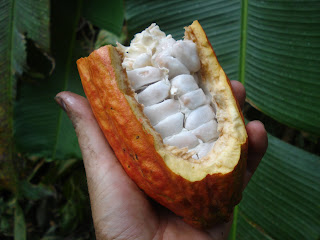
Lunch on on these days in the woods was provided by the finca owner, who is having the wood cut to rebuild his house. His wife and daughter were along working on their plantings of yucca, Otoy, dacheen and nyame--the staple root crops, that along with boiled green bananas and planatains make up the bulk of the Ngäbe diet. They steamed up heaping banana leaves full of yucca for each of us. All of these starchy roots share a taste and texture similar to potatoes and the people here eat loads of it. Adding a little more interest to the menu were steaming cups of cacao, the sugary crude chocolate drink made from the fermented and ground seeds from the fruit of the cacao tree. Even better on a hot day in the forest is cracking open a ripe cacao and sucking the sweet gooey pulp that surrounds the seeds inside.


I spent the week before Thanksgiving working with another volunteer over on the Carribean side of the Peninsula build a composting latrine on the gorgeous beach that´s pictured at the top of this post. The project was a good learning experience in many ways, full of challenges with the rainy November days, the need for improvising to overcome shortages of tools and materials, and just the unique task of mobilizing the local work force. Nonetheless, the latrine base is finished and ready for the privy or casita to be added above. I plan to do a lot of work with latrines, as there are almost none in my community, but I´ll save all that for another day.

Tuesday, October 13, 2009

Site visit


I´m just back in the capital after a week visiting Bahia Azul, the community that I´ll be calling home for the next two years and it was just great. All of the Environmental Health trainees from our group went to a town a few hours west of here to meet with our ¨counterparts,¨ or sponsors from our communities. After an evening and morning of sessions to get them aquainted with us and the ways Peace Corps a group of us headed out together across the country to the Bocas Del Toro region. The bus ride across the Cordillera Central always provides magnificent views which the guys from the communities seemed to enjoy as much as we did. At Chiriqui Grande my counterpart and I split from the rest of the group and caught a boat for the two hour ride out to Bahia Azul. As required by tradition I´d been given a Ngäbe nickname, so as we approaced and the men gathered at the dock hollered out to me, "Mä ka ño?" (What´s your name?), my response "Tolichi" brought huge smiles and echos of "Tolichi ! Tolichi !" Variations on this were repeated throughout the week as I went about the town meeting people and visiting their homes. Everyone in the community is Ngäbe, and they speak Ngäbere almost all the time among themselves, but nearly everyone seemed to easily switch to Spanish to talk to me or to include me in a conversation. Their was a meeting Sunday where I was formally presented to the community and so I gave the short speech in Ngäbere that I´d been practicing, and then talked for a while in Spanish about Peace Corps, my idea of my role in the community and some general ideas about water and sanitation projects. Everyone was very receptive and they have already have some ideas for what they want to accomplish, some that are definitely more realistic than others, but I´ll share more about all of that in a later post as I settle in and start the work of community analysis and "Proyecto Amistad."


Overall it was just a great week. The setting is really remarkably beautiful. Bahía Azul is a deep and narrow bay at the end of a long peninsula that juts out into the Carribean Sea. The steep hills rising from the crysalline waters of the bay are covered in dense and lush tropical forest. The community of sixty or so houses is built around a central community area that includes the school and ball field, a health center and the town´s one tiny store. The small wooden house I´ll be living in for the next few months is built on a dock extending out from the shore and is the home of a delightful couple who made me feel immediately at home. I shot a few photos from the kitchen windows one morning, including the one that shows the clever reuse of a section of an old canoe for the kitchen sink. Aside from visiting around the community I got involved in some group work days, and learned to tie penca, the palm leaf that is used to thatch roofs here. There is no electric power in town so when the sun goes down everything gets very tranquilo, lit only by kerosene lantern, and it was easy for me to turn in early and fall asleep to the sound of the waves lapping up on the shore literally under my room. I definitely felt like I could get use to living there.


Two weeks back in the training site to finish things up and then Swear-in, and the final move to site. More details to come.

Saturday, September 19, 2009

Culture Week


I´ve been out in Bocas Del Toro for the past week with the ten other "aspirantes" who will be moving out to that area of Panama for their service. Team Bocas!

We stayed with local families in a little Ngäbe village on Isla San Cristobal for a week of language and cultural training. Really a very beautiful place and beautiful people. I loved it and found it to be very much the kind of place where a Peace Corps volunteer could feel welcomed and needed. Especially environmental health volunteers like my group specializing in potable water and sanitation. In the community of several hundred people there is one composting latrine. Aside from that there are some "servicios" perched over the bay or little creeks running through the community. There is a gravity fed aquaduct that brings water from the hills above, but many of the homes aren´t connected, so we bathed and got water from a pair of community "quebradas" where a pipe from a stream above the village emptied out into a little creek (see picture above). We treated the water with chlorine or iodine before drinking it in case you were concerned.

Also in pic´s above are a shot of a woman crushing some seeds to make a dye for the fiber they use to make woven bags, a small money-making artisanry endeavor. Another shot of local kids and a couple of my PC colleagues out on a hike.
We´re all heading on to another Ngäbe town up in the hills of central Panama this week for "Tech Week" to work on latrine and aquaduct projects. I think that the rest of training is going to fly by. ´We´re back in our home base at the end of next week, but then out to our own sites for a five day visit before swear-in on October 22. I´ll hope to be able to post another update sometime soon.